
0 of 8 lessons completed · 0% complete
Espresso Basics: Dose, Yield and Time
A repeatable espresso recipe begins with three numbers: dose, yield and time.
By KAVOVOUpdated 6 minutes read
The short answer
An espresso recipe needs three numbers:
- Dose: the mass of dry coffee in the basket.
- Yield: the mass of liquid espresso in the cup.
- Time: how long it takes to reach that yield.
A useful starting point is 18 g in, 36 g out, in roughly 25–35 seconds. That is a 1:2 brew ratio. It is a starting recipe, not a law of nature. Keep the dose suitable for your basket, use yield to define when the shot stops and use taste to decide what to change.
Dose: coffee in
Dose is the mass of dry ground coffee placed in the basket. Weigh it after grinding rather than trusting a grinder timer or measuring spoon.
The basket determines the sensible dose range. If it is designed for about 18 g, begin near 18 g. A 14 g basket and a 22 g basket need different doses because the coffee bed must sit at a workable depth with enough space above it for the machine’s shower screen.
Too little coffee can leave a shallow, wet puck and produce very fast flow. Too much can press the puck against the shower screen, disturb the surface and restrict flow. More coffee does not automatically mean stronger or better espresso; it means you have changed the recipe.
Choose a dose that suits the basket, then keep it fixed while dialing in. A variation of half a gram can be enough to change shot time.
Yield: espresso out
Yield is the mass of espresso in the cup. Measure it in grams, not millilitres. Crema contains gas and can make two visually identical cups contain different amounts of liquid.
Yield determines the brew ratio:
| Dose | Yield | Brew ratio | General character |
|---|---|---|---|
| 18 g | 27 g | 1:1.5 | Shorter, heavier and more concentrated |
| 18 g | 36 g | 1:2 | Balanced starting point for many coffees |
| 18 g | 45 g | 1:2.5 | Longer, lighter and often more extracted |
To calculate the ratio, divide yield by dose. A 36 g yield from an 18 g dose is 36 ÷ 18 = 2, or 1:2.
Longer is not always better. Increasing yield usually extracts more from the coffee, but it also makes the drink less concentrated. Darker roasts may taste balanced with a shorter ratio, while lighter roasts may benefit from a little more yield.
Time: a diagnostic clue
Time tells you how quickly water moved through the coffee bed. It helps reveal whether the grind and puck preparation created sensible resistance.
Choose one timing convention and use it consistently. On most home machines, the simplest method is to start the timer when you start the pump and stop it when the target yield is reached. Machines with long or adjustable pre-infusion make direct time comparisons less useful, so compare shots made with the same machine settings.
For an 18 g in, 36 g out starting recipe, roughly 25–35 seconds is a practical first target. Then taste:
- 36 g in 18 seconds will often be thin, sharp or underdeveloped;
- 36 g in 50 seconds may be dry, harsh or overly heavy;
- 36 g in 30 seconds can still taste poor if the coffee, temperature or puck preparation is wrong.
The clock is evidence. Your palate delivers the verdict.
Why all three numbers matter
“My espresso took 30 seconds” is not a complete recipe. Thirty seconds could produce 20 g or 70 g of liquid, and those drinks will taste very different.
Record the recipe in this order:
18 g dose → 36 g yield → 29 seconds
Add the grinder setting and a short taste note if you want to repeat or improve it:
Grinder 8 · sweet, slight sharp finish
This gives you a useful comparison for the next shot.
What to keep fixed
During the first stage of dialing in:
- Use the same coffee.
- Keep the dose fixed.
- Stop at the same yield.
- Keep water temperature and pre-infusion unchanged.
- Adjust grind size to change the shot time and flow.
Once the shot lands in a sensible range, taste it. Only then decide whether the ratio itself needs changing.
Try this today
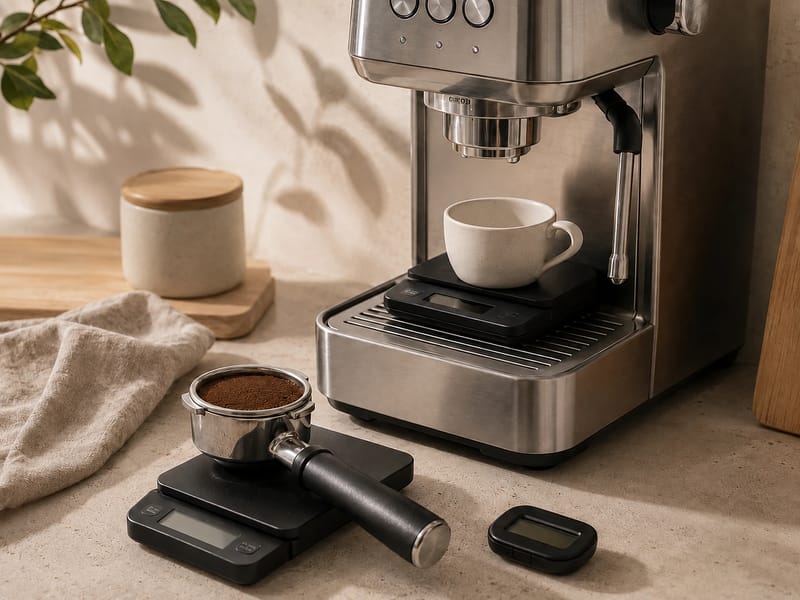
Place the empty portafilter on the scale and tare it. Grind and record the exact dose. Put the cup on the scale, tare again and stop the shot at twice the dose. Record the time and one plain-language taste note: sour, sweet, bitter, thin, heavy or balanced.
You now have a complete espresso recipe rather than a cup that merely happened.
Key takeaway
Dose defines how much dry coffee you use, yield defines how much espresso you make and time shows how quickly you reached it. Start near a 1:2 ratio, keep the dose and yield consistent, and let taste guide the final adjustment.
Finished this lesson?
0 of 8 lessons completed · 0% complete