
0 of 7 lessons completed · 0% complete
Washed, Natural and Honey Processing
The way coffee fruit is removed and dried can shift clarity, fruit intensity, sweetness and body.
By KAVOVO7 minutes read
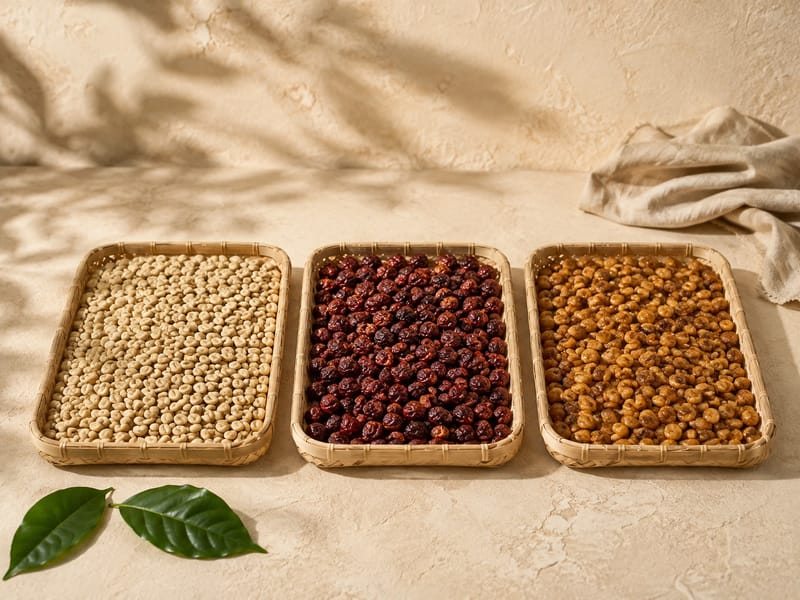
The short answer
Coffee processing is how producers remove, manage and dry the fruit around the coffee seed.
- Washed: most fruit is removed before drying. Often clean, bright and easy to read in the cup.
- Natural: the whole cherry dries around the seed. Often fruitier, heavier and sometimes more fermented.
- Honey: the skin is removed but some sticky fruit layer remains during drying. Often combines sweetness and body with clearer acidity.
No honey is added during honey processing. The name refers to the sticky, honey-like feel of the fruit mucilage.
Coffee begins as a fruit
The “bean” is usually one of two seeds inside a coffee cherry. Around it sit layers of skin, pulp, sticky mucilage and parchment.
After harvesting, producers need to remove those outer layers and reduce moisture enough for the coffee to be stored safely. How and when they remove the fruit affects fermentation, drying and flavour.
Processing cannot rescue unripe cherries or careless drying, but it can reveal or transform the character of good fruit.
Washed process
In a typical washed process:
- ripe cherries are sorted;
- machines remove the skin and much of the pulp;
- fermentation or mechanical action helps remove remaining mucilage;
- the coffee is washed with clean water;
- parchment coffee is dried on patios, raised beds or mechanical dryers.
There are many regional variations. Some coffees ferment under water, some in relatively dry tanks, and some use mechanical demucilaging with less fermentation.
Common cup tendencies
Washed coffees are often associated with:
- clearer acidity;
- more transparent variety and origin character;
- a lighter or cleaner body;
- citrus, floral, stone-fruit, caramel or tea-like notes.
“Clean” does not mean simple, and washed coffee is not literally washed of flavour. It means fermentation and drying flavours may be less dominant.
Practical trade-offs
Washed processing can produce consistent lots when well controlled. Traditional methods may use significant water, although modern systems can reduce and treat wastewater.
Natural process
In a natural or dry process, the whole cherry dries with the seed inside.
- cherries are sorted for ripeness and defects;
- they are spread in thin layers;
- workers turn them frequently for even drying;
- once stable, the dried fruit and parchment are mechanically removed.
Because the seed spends longer inside the fruit, drying and microbial activity can influence flavour strongly.
Common cup tendencies
Natural coffees often show:
- fuller or syrupy body;
- berries, tropical fruit or dried-fruit notes;
- pronounced sweetness;
- wine-like or fermented character.
At the cleaner end, a natural coffee can taste like ripe fruit with clear structure. Poor sorting or uncontrolled drying can produce mouldy, alcoholic, medicinal or over-fermented defects.
Natural processing often suits dry climates, but careful production still requires labour, space and reliable drying conditions.
Honey process
Honey processing begins by removing the cherry skin while leaving some mucilage attached to the parchment. The sticky coffee is then dried carefully.
The result often sits somewhere between washed clarity and natural fruit intensity, but it is its own broad family of methods.
Yellow, red and black honey
You may see colours used to describe honey processes. They can refer to how much mucilage remains, how slowly the coffee dries, how much shade it receives or the final appearance of the parchment.
These terms are not perfectly standardised between countries and producers. A black honey from one farm may not follow the same recipe as a black honey from another.
Use the colour as a clue, then read the producer’s description if available.
Common cup tendencies
Honey-processed coffees are often associated with:
- rounded sweetness;
- medium to full body;
- ripe fruit, caramel or honey-like associations;
- clearer acidity than many naturals.
Again, the word honey describes texture during production. Bees are not on the processing payroll.
Process does not work alone
The same process can taste different depending on:
- coffee variety and cherry ripeness;
- fermentation time and temperature;
- local microbial activity;
- drying speed, humidity and airflow;
- storage conditions;
- roast level.
A dark roast can cover much of the distinction. A very fermentation-forward experimental coffee can dominate the character of its origin.
What about anaerobic and experimental processing?
Some producers ferment coffee in sealed or low-oxygen vessels, use carbonic-maceration-inspired methods, add selected yeasts or control temperature precisely.
“Anaerobic” does not describe one flavour or one full process. It usually identifies a fermentation environment, after which the coffee may be washed, dried as a natural or handled in another way.
These coffees can be vivid, spicy, tropical or unusual. They can also become heavily fermented. Buy them because you enjoy the profile, not because a laboratory-sounding word guarantees quality.
Which process should you choose?
- Choose washed when you enjoy clarity, structured acidity and origin character.
- Choose natural when you enjoy strong fruit, sweetness and fuller body.
- Choose honey when you want sweetness and body with moderate clarity.
These are starting expectations. The flavour notes and roaster description remain more useful than the process name alone.
Try this today
Taste a washed and natural coffee from the same country—or, ideally, the same producer and variety. Brew them at the same ratio. Compare fruit intensity, acidity, body, sweetness and aftertaste.
If everything except process is similar, the comparison becomes much easier to understand.
Key takeaway
Washed, natural and honey processing describe how fruit is removed and coffee is dried. Each method creates common flavour tendencies, but careful harvesting, fermentation and drying matter more than the label alone.
Finished this lesson?
0 of 7 lessons completed · 0% complete