
0 of 7 lessons completed · 0% complete
Coffee Roast Levels Explained
Light, medium and dark describe a spectrum, and each roaster draws the boundaries differently.
By KAVOVOUpdated 6 minutes read
The short answer
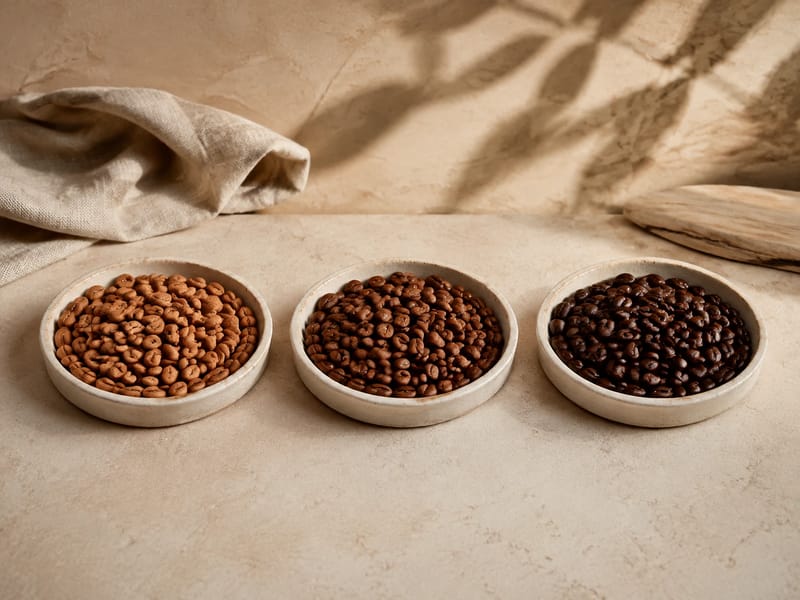
Roast level describes how far coffee has been developed through heat.
- Light roast: more origin character, brighter acidity and less roast flavour; usually harder to extract.
- Medium roast: a balance of origin character, sweetness and roast development.
- Dark roast: more roasted, bitter, smoky or dark-chocolate character; usually easier to extract.
There is no universal colour boundary between light, medium and dark. One roaster’s medium may be another roaster’s light.
What roasting does
Green coffee is dense, grassy and not ready to brew. Roasting applies heat to drive chemical and physical changes:
- moisture decreases;
- the bean expands and becomes more brittle;
- sugars, amino acids and other compounds react;
- hundreds of aromatic compounds form and change;
- acidity, sweetness, bitterness and solubility shift.
The roaster chooses how quickly heat is applied, when the roast ends and how the coffee is cooled. Final colour matters, but the journey to that colour matters too.
Two coffees with similar surface colour can taste different if their roast development was different.
Light roast
Light-roasted beans are usually lighter brown, dense and dry-looking. They preserve more of the acidity and aromatic differences linked with variety, origin and process.
Common associations include:
- citrus, berries or stone fruit;
- floral or tea-like aroma;
- vivid acidity;
- lighter body;
- less obvious smoky or bitter roast flavour.
Light roast does not mean weak. Strength depends on the coffee-to-water ratio. A light roast can produce a very strong drink and still taste sharply under-extracted if the grind, temperature or contact time is unsuitable.
Because lighter beans are dense and less soluble, they often benefit from finer grinding, hotter water or longer contact than darker coffee.
Medium roast
Medium roast aims to balance origin character with greater caramelisation and easier extraction.
Common associations include:
- caramel, milk chocolate and nuts;
- rounded fruit;
- moderate acidity;
- fuller sweetness and body;
- less dominant roast bitterness than dark coffee.
This broad range suits many filter methods, espresso and milk drinks. “Medium” covers a lot of territory, so use the flavour notes and roaster’s brewing recommendation as well.
Dark roast
Dark-roasted beans are deeper brown, more porous and sometimes oily at the surface. With further development, roast character becomes more prominent and differences between origins can become less obvious.
Common associations include:
- dark chocolate and caramelised sugar;
- toast, smoke or spice;
- heavier bitterness;
- lower perceived acidity;
- full body and a lingering roast finish.
Dark roast is usually more soluble, so it can extract quickly. Slightly cooler water, a coarser grind or a shorter brew may reduce harshness.
Very dark does not automatically mean stronger in caffeine. Caffeine changes less dramatically during roasting than colour and aroma do. Dose and serving size are more useful predictors of how much caffeine reaches the drink.
Roast labels are not standards
Terms such as cinnamon, city, full city, French and Italian roast appear in some traditions, but their use varies.
Professional roasters may measure colour with systems such as the Agtron scale. Even then, colour is one measurement rather than a complete sensory description.
On a retail bag, “light”, “medium” and “dark” should be read as the roaster’s position within its own range. Comparing labels between different roasters is less reliable.
Espresso roast and filter roast
These terms describe intended use more than fixed colour.
- A filter roast may be developed to retain clarity and work well with longer, gentler brewing.
- An espresso roast may be developed for easier extraction, body and balance under pressure.
- An omni roast is intended to work across several methods.
An espresso roast can still be relatively light, and a filter roast is not always pale. Start with the roaster’s recipe, then adjust by taste.
Which roast should you choose?
Choose by flavour rather than status.
- If you enjoy floral, fruit-led and bright coffee, begin lighter.
- If you want caramel, chocolate and balanced fruit, begin around medium.
- If you prefer low perceived acidity, heavy roast character and traditional intensity, choose darker.
- For milk drinks, medium to dark coffee often remains easier to taste through milk, although fruit-led light espresso can be excellent when dialled in well.
No roast level is more advanced. Drinking an intensely sour light roast out of politeness does not unlock a secret level of coffee expertise.
Try this today
Brew light, medium and dark coffees at the same coffee-to-water ratio. Adjust grind only enough to make each brew extract sensibly. Compare acidity, sweetness, bitterness, body and how clearly you can taste the listed origin notes.
Key takeaway
Roast level changes solubility and shifts flavour from origin-led toward roast-led characteristics. Because roast labels are not standardised, use colour, flavour notes, brewing advice and your own preference together.
Finished this lesson?
0 of 7 lessons completed · 0% complete