
0 of 12 lessons completed · 0% complete
Grind Size: From Espresso to French Press
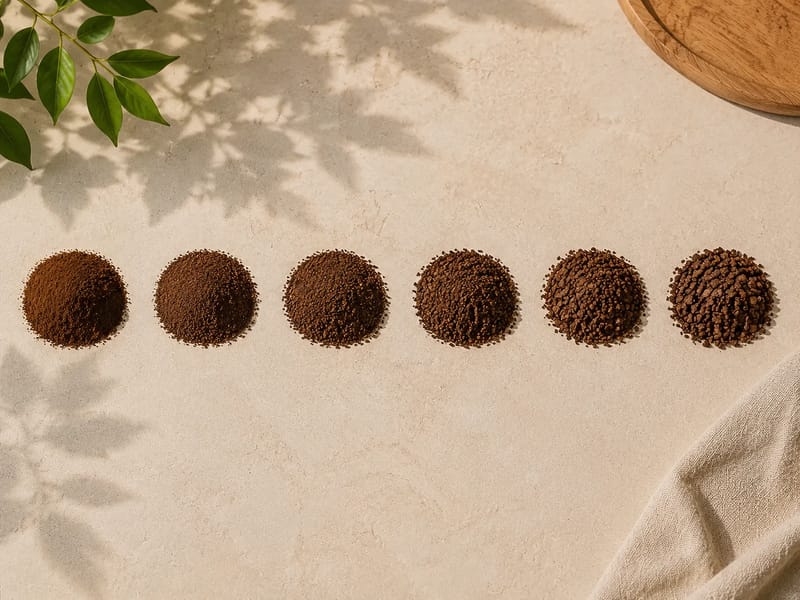
Grind size controls how quickly water can extract flavour from coffee. Finer is faster; coarser is slower.
By KAVOVO6 minutes read
The short answer
Fine coffee exposes more surface area and extracts quickly. Coarse coffee exposes less surface area and extracts more slowly. Match the grind to the contact time and pressure of the brewing method, then adjust by taste.
Why grind size changes flavour
Water extracts acids, sugars, aromatic compounds and bitter material from roasted coffee. The process is not perfectly sequential, but under-extracted coffee often tastes sharp, sour or thin, while over-extracted coffee often tastes dry, bitter or hollow.
Smaller particles give water easier access to the coffee. That is useful for espresso, where brewing lasts only seconds. French press coffee sits in water for several minutes, so a coarser grind helps keep the extraction manageable and the cup cleaner.
Grind size starting points
| Brewing method | Starting grind | Visual comparison |
|---|---|---|
| Turkish coffee | Extra-fine | Powder or flour |
| Espresso | Fine | Finer than table salt |
| Moka pot | Fine to medium-fine | Fine sand |
| AeroPress | Medium-fine to medium | Table salt |
| V60 / pour-over | Medium | Sand |
| Batch filter | Medium | Sand |
| French press | Medium-coarse to coarse | Coarse sea salt |
| Cold brew | Coarse | Coarse sea salt |
These comparisons are approximate. “Medium” on one grinder may look different on another, and different coffees create different amounts of fine particles.
Time and grind work together
Grind size also changes how quickly water moves through a bed of coffee.
- A finer pour-over grind usually slows the drawdown.
- A coarser pour-over grind usually speeds it up.
- A finer espresso grind creates more resistance and slows the shot.
- A coarser espresso grind reduces resistance and speeds the shot.
Immersion brewers such as a French press are less dependent on flow, but grind size still changes extraction and the amount of sediment in the cup.
How to adjust by taste
Start from a sensible setting for the brewer and keep the dose, water and technique unchanged.
If the coffee tastes sour, salty, thin or undeveloped, try grinding finer.
If it tastes dry, harsh, bitter or astringent, try grinding coarser.
Move one or two small grinder steps at a time. Large changes make it difficult to learn what helped.
Taste is more important than brew time, but time is a useful clue. If a pour-over that normally takes three minutes suddenly finishes in ninety seconds, the fast flow is telling you something even before you taste it.
Consistency matters as much as the setting
Every grinder produces a range of particle sizes. Very small particles, often called fines, extract quickly and can slow a filter. Large particles, sometimes called boulders, extract more slowly.
A better burr grinder usually creates a narrower and more useful particle distribution. The result is not automatically delicious, but it is easier to control.
Blade grinders repeatedly chop the coffee and tend to create powder and large fragments at the same time. If a burr grinder is not available, use short pulses and shake the grinder gently between pulses—but treat this as a temporary compromise.
Different coffees may need different settings
Dense, light-roasted coffee often benefits from a finer grind or more energetic extraction. Darker roasts are more soluble and may taste better with a slightly coarser grind or lower temperature.
As beans age, espresso shots often begin to run faster. Small grind adjustments are normal. A grinder setting is not a permanent recipe carved into the side of the machine.
Try this today
Brew your normal recipe. Then brew it again one clear step finer while changing nothing else. Let both cups cool slightly and compare them.
Ask:
- Did sweetness increase?
- Did bitterness or dryness increase?
- Did the body change?
- Which cup has the cleaner finish?
Key takeaway
Choose a grind range that matches the brewer, then let flavour guide the final setting. If the cup is under-extracted, go finer. If it is dry and over-extracted, go coarser.
Finished this lesson?
0 of 12 lessons completed · 0% complete