
AeroPress
A full AeroPress brew guide — the standard method, steep time, filters, pressing technique and how to fix a cup that comes out weak or harsh.
6 minutes read
Jump to quick start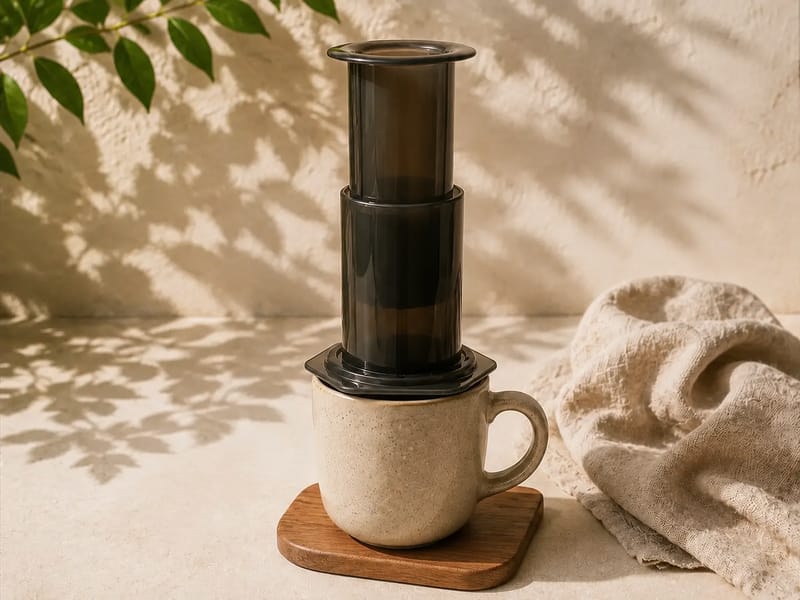
The AeroPress is the most forgiving brewer most people will own. Coffee steeps in a sealed chamber and is then pressed through a filter, so the brew is short, the clean-up takes seconds and almost every mistake can be corrected in the cup.
It suits anyone who wants good coffee without a ritual: one or two cups at a time, on a kitchen counter or in a hotel room. The paper filter keeps the cup clean and free of sediment, while the short steep and gentle pressure give it more body than a pour-over.
The limits are worth knowing. It brews one drink at a time, so it is not the brewer for a table of four. It is also not an espresso machine — the pressure from your arm is a fraction of what a pump produces, so a shorter, stronger brew is a concentrate rather than a shot.
On this page
Quick start
- Coffee
- 15 g
- Water
- 220 ml
- Grind
- Medium-fine
- Water temperature
- 90–95°C
- Brew time
- 4 min
- Brewer
- AeroPress, standard
Equipment
Essential
You cannot brew the method properly without these.
- AeroPressChamber, plunger, filter cap and the rubber seal on the plunger.
- Paper filtersOne per brew. They catch fines and oils, giving a clean cup.
- Burr grinderEven particles matter more here than any other variable you control.
- Digital scaleWeighing coffee and water is what makes a good brew repeatable.
- KettleAny kettle works. You do not need a gooseneck for this method.
- Sturdy mugIt has to take the weight of the press without sliding or tipping.
Useful but optional
These make it easier, not possible.
- TimerYour phone or the timer on a scale is enough to track the steep.
- Metal filterLets more oils through for a heavier cup. Reusable, slightly more sediment.
- Stirrer or spoonA short stir after the pour helps wet every ground evenly.
- Travel capKeeps the chamber sealed in a bag, which is most of the appeal.
How it works
The AeroPress combines two things. First it is an immersion brewer: coffee and water sit together in the chamber, so every ground is in contact with water for the whole steep. That is why the method is consistent — there is no bed for water to channel through and no drawdown to stall.
Then it becomes a press. Pushing the plunger builds gentle pressure and forces the brew through the filter. That pressure is modest, roughly what your arm can apply against a small filter area, and it mostly shortens the time the brew takes to leave the chamber rather than driving extraction.
This matters for what you change. Because extraction happens during the steep, grind size and steep time are your main controls. Pressing harder or faster does not extract more; it only risks pushing water unevenly through the coffee. If the cup is not right, adjust what happened before the plunger moved.
Step-by-step technique
The one thing that matters mostPress slowly. Forcing the plunger does not extract more coffee; it pushes water around the bed and through the weakest point, which is where harsh flavours come from.
- Boil the kettle and rinse the filter in the cap.Rinsing removes papery flavour and warms the chamber, so the brew does not lose heat in the first few seconds.
- Grind 15 g of coffee at a medium-fine setting.Slightly finer than pour-over. Fine enough to extract in a short steep, coarse enough that the press does not become a struggle.
- Assemble the AeroPress on the mug and add the coffee.Check the mug is stable and wide enough to take the brewer squarely. A wobbling mug is the main way this method goes wrong.
- Pour 220 ml of water at 90–95°C, filling the chamber steadily.Pour with enough energy to wet all the grounds. Dry pockets extract far less than the coffee around them.
- Stir gently two or three times, then fit the plunger.The stir breaks up the crust so every ground is submerged. Fitting the plunger without pressing seals the chamber and slows heat loss.
- Steep for four minutes.This is where extraction happens. A shorter steep gives a lighter, sharper cup; a longer one gives more body and more bitterness.
- Press down slowly, taking 20–30 seconds to reach the bed.Slow pressure keeps the flow even. If it becomes hard work, the grind is too fine — ease off rather than forcing it.
- Stop as soon as you hear the hiss of air.Pressing past that point pushes the last, most bitter liquid through and adds nothing worth drinking.
- Eject the puck and rinse the seal.Coffee oils on the rubber seal turn stale quickly, and a clean seal presses more smoothly next time.
Variables that matter
Change one at a time. Two changes at once tell you nothing about either.
Grind size
- What changes
- Finer grinds extract faster and give more body; coarser grinds give a lighter, cleaner cup and press more easily.
- When to reach for it
- Adjust this first when the coffee tastes sharp and thin, or heavy and drying.
Steep time
- What changes
- Longer steeps pull more from the coffee — more sweetness at first, then more bitterness.
- When to reach for it
- Change it when the grind is right but the cup is slightly under- or over-developed.
Ratio
- What changes
- More coffee to the same water makes a stronger drink; more water makes it lighter.
- When to reach for it
- Use it when the cup is balanced but simply too strong or too weak for you.
Water temperature
- What changes
- Hotter water extracts faster. Cooler water softens harshness in darker roasts.
- When to reach for it
- Reach for it after grind and time are settled, not before.
Filter choice
- What changes
- Paper gives a cleaner, lighter cup. Metal lets oils through for a heavier one.
- When to reach for it
- Change it when you like the flavour but want a different texture.
Adjust by taste
Make the change in the last column, brew again, then taste before changing anything else.
| Result | Likely cause | Change first |
|---|---|---|
| Sour, thin or hollow | Under-extraction — the water did not take enough from the coffee | Grind one step finer |
| Bitter, harsh or drying | Over-extraction, or pressing too hard at the end | Grind one step coarser |
| Too strong, but balanced | The concentration is too high for your taste | Add hot water to the cup |
| Too weak, but balanced | The concentration is too low | Use 2 g more coffee at the same water |
| Hard to press | The grind is too fine for the filter | Grind coarser and press more slowly |
Choosing coffee
The AeroPress handles almost anything, which is why it is such a good brewer for exploring. Medium roasts are the easiest starting point: they extract readily in a short steep and forgive small errors in grind and timing.
Light roasts work well and often taste clearer here than in a French press, though they may want a slightly finer grind or hotter water to open up. Dark roasts give a heavy, chocolate-led cup, but they extract quickly — a cooler pour and a shorter steep keep them from turning bitter.
For milk drinks, brew a concentrate: the same 15 g with roughly half the water, then top with hot milk. It will not behave like espresso, but it holds its character better than a full-length brew does.
Troubleshooting
Open the symptom that matches your cup.
The coffee tastes sour and watery
- Likely cause
- The steep was too short or the grind too coarse for the time
- Change first
- Grind one step finer and keep everything else the same
- Check next
- If it is still sour, extend the steep by 30 seconds
The coffee tastes bitter and dries the mouth
- Likely cause
- Too much extraction, often from a fine grind plus a hard press
- Change first
- Grind one step coarser
- Check next
- Press more slowly and stop at the hiss rather than pushing through it
The plunger is very hard to push
- Likely cause
- The grind is too fine, or the filter is blocked by fines
- Change first
- Move the grinder coarser by one or two steps
- Check next
- Check the filter sits flat in the cap and the seal is clean
Water leaks from the cap while steeping
- Likely cause
- The cap is not seated squarely, or the chamber rim has grounds on it
- Change first
- Wipe the rim and refit the cap until it clicks all round
- Check next
- Check the filter is centred and not folded at the edge
The cup tastes flat and papery
- Likely cause
- The filter was not rinsed, or the water is heavily chlorinated
- Change first
- Rinse the filter with hot water before adding coffee
- Check next
- Try filtered water and compare the two cups side by side
Every brew tastes slightly different
- Likely cause
- Something is being estimated rather than measured
- Change first
- Weigh both the coffee and the water
- Check next
- Fix the steep time and change only one variable between brews
Still not right?
The table above covers the usual faults. If yours is not on it, describe the brew you actually got and the assistant works back to one change — with AeroPressalready selected.
Fix my next brewCleaning and care
After each brew, eject the puck straight into the bin, rinse the chamber and wipe the rubber seal. The seal is where oils collect fastest, and a sticky seal makes the next press feel rough long before it starts affecting the flavour.
Every week or so, take the plunger seal off and wash both parts in warm soapy water. Rinse the filter cap thoroughly — the small holes trap grounds that go stale and add a dull, old-coffee note to an otherwise clean cup.
The rubber seal is a wear part. When it hardens, loses its shine or stops sliding smoothly, replace it. A tired seal lets air past during the press, which is often mistaken for a grind problem.
Recipes with this method
Put the method into practice with one of these tested KAVOVO recipes.