
0 of 12 lessons completed · 0% complete
Coffee Brewing Temperature, Explained
There is no single perfect temperature for every coffee. Start with a sensible range and adjust only when taste gives you a reason.
By KAVOVO5 minutes read
The short answer
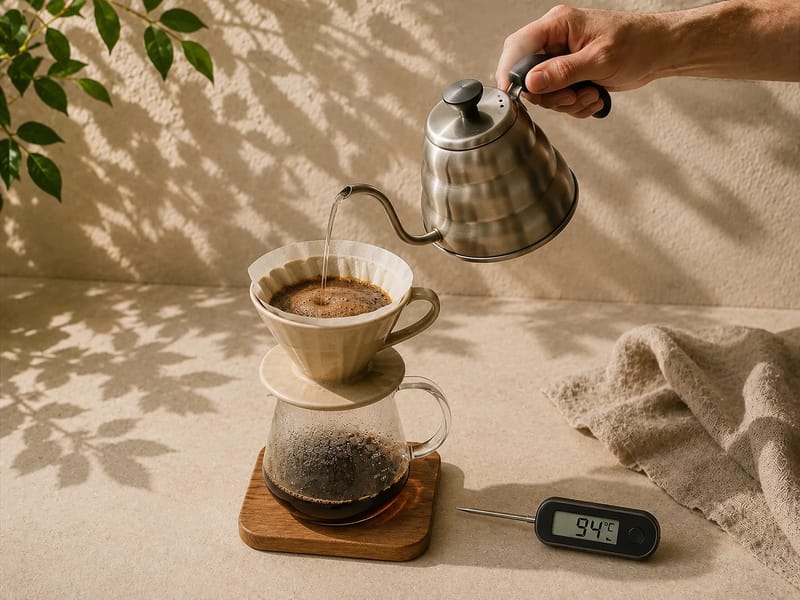
For most hot filter coffee, start between 92°C and 96°C. Use hotter water for coffees that are difficult to extract and slightly cooler water for dark roasts that become harsh easily.
Temperature matters, but it works together with grind size, ratio, time and agitation. It is not a magic flavour dial.
What hotter water does
Hotter water generally increases the speed of extraction. It can help bring sweetness and complexity from dense, lightly roasted coffee.
If the rest of the recipe stays the same, hotter water may also increase bitterness, dryness or roast flavour—especially with darker coffee.
Cooler water generally extracts more slowly. That can soften harshness, but water that is too cool may produce a cup that tastes sour, thin or undeveloped.
Useful starting ranges
| Coffee or method | Starting temperature |
|---|---|
| Light-roast filter coffee | 94–96°C |
| Medium-roast filter coffee | 92–94°C |
| Dark-roast filter coffee | 88–92°C |
| AeroPress | 85–94°C, depending on recipe |
| French press | 92–96°C |
| Espresso | Commonly 90–94°C |
| Cold brew | Cold or room-temperature water |
These are practical starting ranges, not fixed rules. The roast description on the bag is also subjective, and two coffees with the same label may behave differently.
Do you need a temperature-controlled kettle?
No. It is convenient, particularly for repeatable pour-over recipes, but it is not essential.
With a normal kettle:
- Bring fresh water to the boil.
- Open the lid or wait briefly.
- Begin brewing after approximately 30–60 seconds.
The actual temperature depends on the kettle, room, volume of water and altitude, so treat the waiting time as an approximation.
Preheating the brewer and cup helps prevent a large temperature drop during brewing.
Temperature should not be your first random adjustment
If a brew tastes wrong, check the obvious variables first:
- Was the coffee and water weighed?
- Did the grind setting change?
- Was the brew much faster or slower than normal?
- Was the coffee fresh?
Once those variables are stable, temperature becomes easier to understand.
Try hotter water when the coffee is consistently sour, thin or difficult to extract even after a sensible grind adjustment.
Try cooler water when a darker roast tastes burnt, rough or aggressively bitter despite a suitable ratio and brew time.
Brewing temperature is not serving temperature
Coffee is difficult to taste when it is extremely hot. Heat suppresses some flavour perception and can make every cup seem simpler than it really is.
Allow the coffee to cool for several minutes. Many flavours become clearer as the cup moves from hot to comfortably warm.
There is no universal perfect number
Controlled coffee research has shown that brews made at different temperatures can taste very similar when strength and extraction are kept comparable. In practical terms, this means temperature is only one part of a recipe.
A well-adjusted brew at 90°C can be better than a poorly adjusted brew at the supposedly perfect 94°C.
Try this today
Brew the same coffee twice with the same dose, ratio and grind:
- Brew A at approximately 94°C.
- Brew B at approximately 89–90°C.
Taste both as they cool. Notice whether acidity, roast character, sweetness or dryness changes.
Key takeaway
Start at 92–96°C for most filter coffee, adjust for roast level and use taste—not internet certainty—to decide whether hotter or cooler is better.
Finished this lesson?
0 of 12 lessons completed · 0% complete