
The Myth of the Perfect Coffee Recipe
A recipe can give you numbers, but it cannot taste the cup for you. Better coffee begins when you treat the recipe as a starting point rather than a promise.
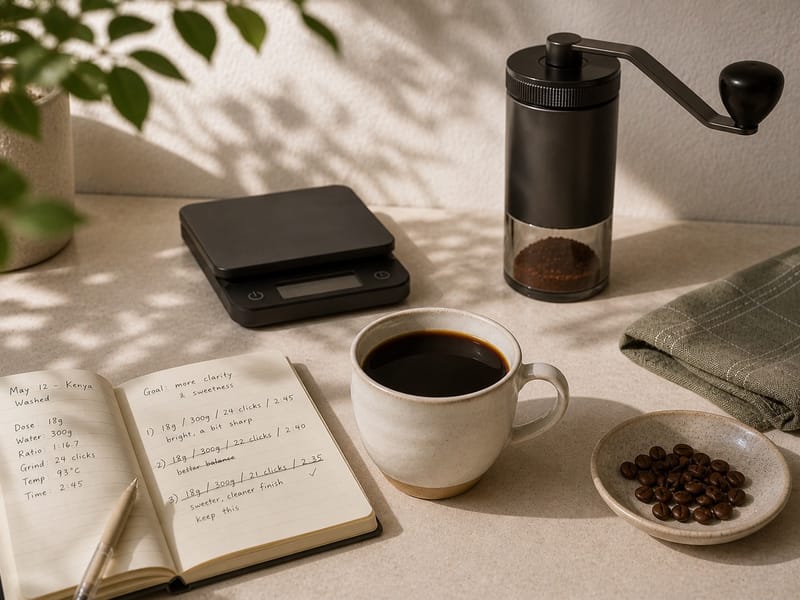
A coffee recipe can tell you how much coffee to use, how much water to add and when to stop the brew. It can give you a sensible grind setting, a temperature range and a target time.
What it cannot do is taste the cup for you.
This is the uncomfortable truth behind every precise coffee recipe: the numbers can be correct and the result can still be wrong for the coffee, the equipment or the person drinking it.
That does not make recipes useless. It makes them what they were always supposed to be — reliable starting points rather than guarantees.
A Recipe Is a Starting Point
Imagine two people following the same pour-over recipe:
- 18 g of coffee;
- 300 g of water;
- a medium grind;
- water at 94°C;
- a total brew time of three minutes.
The first person uses a light-roasted coffee ten days after roasting, soft filtered water and a well-aligned grinder. The second uses a darker coffee that has been open for six weeks, hard tap water and a grinder that produces a wide mix of particle sizes.
The written recipe is identical. The brewing conditions are not.
One cup may taste clear and sweet. The other may be bitter, flat or strangely hollow. Repeating the same numbers more carefully will not necessarily make the cups taste the same.
A useful recipe controls the variables it can control. A thoughtful brewer notices the ones it cannot.
The Same Coffee Does Not Stay the Same
Even one bag of coffee changes as you use it.
Roasted coffee releases gas, absorbs oxygen and gradually loses aroma. During the first days after roasting, trapped gas can make brewing less predictable. Later, as the coffee ages, the same grind setting may allow water to move through the grounds differently.
This is why a recipe that tasted excellent last week may taste slightly thin today. Nothing dramatic has happened. The coffee has simply continued to change.
You do not need to redesign the recipe every morning. But you should expect occasional small adjustments, especially to grind size.
The recipe remains your reference point. It just should not become a rule you are afraid to question.
Your Equipment Has Its Own Version of “Medium”
Recipes often describe a grind as fine, medium or coarse. These words are useful, but they are not universal settings.
Medium on one grinder can be noticeably finer than medium on another. Two grinders of the same model may also behave differently because of burr alignment, calibration, wear or manufacturing variation.
The brewer matters too. A V60 filter may drain differently from another paper that looks almost identical. An espresso basket may prefer an 18 g dose while another basket works better at 20 g. A kettle that pours gently will disturb the coffee bed differently from one with a fast, heavy stream.
This is why the grind size guide describes grind by its effect on the brew, not only by how the grounds look.
If water moves too quickly and the coffee tastes sharp or thin, grind finer. If it moves too slowly and the cup tastes dry or harsh, grind coarser. The grinder number is only a way to return to the setting that worked.
Water Quietly Changes Everything
Coffee is mostly water, yet water is often treated as background scenery.
Water with very little mineral content may struggle to produce a satisfying cup. Water with excessive hardness can mute acidity, emphasise chalky flavours and leave scale inside equipment. Chlorine and other noticeable tap-water flavours do not disappear simply because coffee is added.
Temperature matters as well, but it should not be used as the first answer to every problem. A repeatable dose, ratio and grind give you a clearer foundation. Temperature can then be adjusted with purpose rather than hope.
The coffee brewing temperature guide explains when a hotter or cooler brew is likely to help. The Coffee-to-Water Ratio Calculator gives you a stable starting concentration before you change anything else.
Precision Is Useful — Until It Becomes Theatre
There is value in weighing coffee and water. There is value in timing a brew and recording the final espresso yield. Measurements make a result repeatable, and repeatability makes improvement possible.
But precision can become a performance.
Recording 18.0 g of coffee, 300.0 g of water and a brew time of exactly 3:02 does not guarantee that the cup tastes good. More decimal places do not make a poor decision more correct.
Measure the variables that help you understand the brew. Do not collect numbers merely because the scale can display them.
For filter coffee, dose, water, grind and time are usually enough. For espresso, dose, beverage yield and extraction time form a practical base. Our Espresso Ratio guide can calculate the target yield; taste still decides whether that target suits the coffee.
Consistency Comes Before Correction
Before changing a recipe, make sure you can repeat it.
If the dose changes, the pouring pattern changes and the brew time changes all at once, the next cup cannot teach you much. It may taste better, but you will not know why.
A consistent brew does not need to be perfect. It only needs to be stable enough that one adjustment produces information.
Start by keeping these things fixed:
- the coffee dose;
- the total water or espresso yield;
- the brewing method;
- the water source;
- the main preparation technique.
Then identify the clearest problem in the cup.
Does it taste sour and thin? Bitter and dry? Weak but otherwise pleasant? Heavy and muddled? Use ordinary language. You do not need to identify bergamot, white peach or the emotional atmosphere of a Tuscan orchard before breakfast.
Change One Thing at a Time
This is the simplest rule in coffee and one of the easiest to ignore.
If espresso tastes sour, it is tempting to grind finer, increase the yield, raise the temperature and tamp harder. If the next shot tastes better, four variables are now competing to take the credit.
Change one thing.
For espresso, grind size is often the most useful first adjustment when dose and yield are already sensible. For filter coffee, grind is also a practical place to begin once the ratio and pouring method are stable.
After the adjustment, brew again and compare:
- What improved?
- What became worse?
- Is the cup now enjoyable?
- Does it need another small change?
This approach may feel slower than changing everything. In practice, it reaches a reliable result faster because each brew tells you something.
It is also the principle behind the KAVOVO Brew Assistant: one diagnosis, one change and a clear target for the next brew.
Decide What “Better” Means
Coffee advice often assumes that everyone is trying to reach the same cup.
They are not.
One person wants a bright, tea-like V60. Another wants sweetness without sharp acidity. One espresso drinker enjoys a short, dense shot; another prefers a longer ratio with more clarity. A flat white at home does not have to imitate a competition drink to be successful.
Technical language is useful when it helps you make a decision. It becomes less useful when it persuades you to dislike a coffee you were enjoying.
The goal is not to produce the theoretically correct cup. The goal is to understand the relationship between what you changed and what you tasted — then stop when the coffee is good for you.
A Practical Way to Use Any Recipe
When trying a new coffee or method, use this simple process:
1. Follow the recipe once
Use the recommended dose, ratio, grind range and time. Give the recipe a fair first attempt before rewriting it.
2. Describe the result simply
Choose the clearest description: sour, bitter, weak, strong, dry, flat, heavy or balanced.
3. Select one adjustment
Change the variable most directly connected to the problem. Usually this means a small grind change before altering the entire recipe.
4. Repeat the brew
Keep everything else as consistent as reasonably possible.
5. Stop when the cup is good
Do not continue adjusting because a different number looks more professional. A recipe is finished when you want to drink the result again.
The KAVOVO Approach
KAVOVO recipes use exact doses, useful ranges and practical troubleshooting because vague instructions are difficult to repeat. But the numbers are not presented as commandments.
They create a common starting point.
From there, the coffee, water, equipment and your taste take part in the decision. That is not a flaw in home brewing. It is the reason learning a few basic principles is more valuable than collecting hundreds of recipes.
There is no perfect coffee recipe that works everywhere, forever and for everyone.
There can be a recipe that works today, with this coffee, in your kitchen — and a process that helps you find it again tomorrow.