
0 of 8 lessons completed · 0% complete
Grind Finer or Coarser? A Simple Guide
Finer slows the shot; coarser speeds it up. Taste tells you whether the change helped.
By KAVOVO5 minutes read
The short answer
- Grind finer when the target yield arrives too quickly and the espresso tastes thin, sharp or sour.
- Grind coarser when the target yield arrives too slowly and the espresso tastes harsh, heavy, dry or bitter.
- Do not change grind first when the shot sprays, flows strongly from one side or tastes both sour and bitter. Fix distribution and tamping because uneven flow may be the real problem.
Keep dose and yield fixed while changing grind, and make small adjustments.
What grind size changes
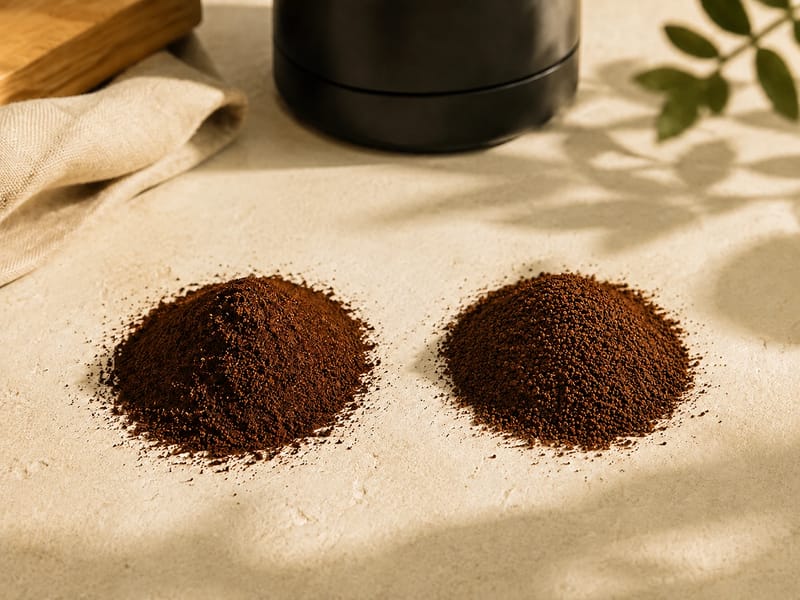
Finer coffee creates more surface area and usually makes it harder for water to move through the puck. The shot slows down and extraction tends to increase.
Coarser coffee usually allows water to pass more easily. The shot speeds up and extraction tends to decrease.
This is why grind size is the main control used during dial-in. It changes flow without requiring you to redesign the entire recipe.
The simple decision table
| Shot behaviour | Taste | Adjustment |
|---|---|---|
| Much too fast | Thin, sharp, sour | Finer |
| Slightly fast | Pleasant but weak or underdeveloped | Slightly finer |
| Much too slow or only dripping | Harsh, heavy, dry, bitter | Coarser |
| Slightly slow | Sweet but too intense | Taste first; perhaps slightly coarser or use a shorter yield |
| Normal time, even flow | Balanced and sweet | Keep the setting |
| Normal time, uneven or spraying flow | Sour and bitter, inconsistent | Improve puck preparation |
Time without taste is incomplete. A shot that runs in 24 seconds may be excellent, while one at exactly 30 seconds may be dull or astringent.
How large should the adjustment be?
Start small when the shot is close. One click on a stepped grinder or a slight movement on a stepless dial can change espresso noticeably.
Make a larger move only when the shot is far outside the useful range—for example, when the target yield arrives in 12 seconds or the machine barely produces drops.
If the grinder uses numbers, do not assume a higher number always means coarser. Check the markings or manual. Manufacturers enjoy keeping this tiny mystery alive.
Adjust safely and purge sensibly
Follow the grinder instructions. Many grinders should be running or empty when the burrs are moved finer, because trapped beans can resist the adjustment.
Some ground coffee remains inside the chute after grinding. After changing the setting, purge enough coffee to clear grounds from the previous setting. The amount depends on the grinder; wasting a full basket every time is rarely necessary.
If the first dose after an adjustment behaves strangely, retention may be the reason. Pull another shot before making a second large correction.
When finer stops helping
Grinding finer can eventually make flow less even. Very fine coffee may clump, make puck preparation difficult or create so much resistance that water finds a weak path around the dense areas.
If a finer setting produces a slow shot that is still sharp and drying:
- return slightly coarser;
- improve distribution;
- check that the basket is not overdosed;
- consider a slightly longer yield instead of another finer step.
The finest possible grind is not the goal. Even, controllable extraction is.
When coarser is not enough
If a coarser setting still produces a very slow shot, check for:
- too much coffee in the basket;
- a blocked basket or dirty shower screen;
- a grinder that was not purged after adjustment;
- an unusually high dose caused by timer drift;
- a machine pressure or flow problem.
Likewise, if every setting runs fast, confirm the dose, bean freshness and grinder’s espresso capability.
Try this today
Use one fixed dose and yield. Pull a shot, move the grinder one small step finer and pull again. Record the time difference and taste both after stirring.
That tells you how sensitive one adjustment is on your grinder—a far more useful fact than someone else’s setting number.
Key takeaway
Finer usually slows the shot and increases extraction; coarser usually speeds it up and reduces extraction. Make small changes, keep dose and yield fixed, and use taste to confirm the direction.
Finished this lesson?
0 of 8 lessons completed · 0% complete